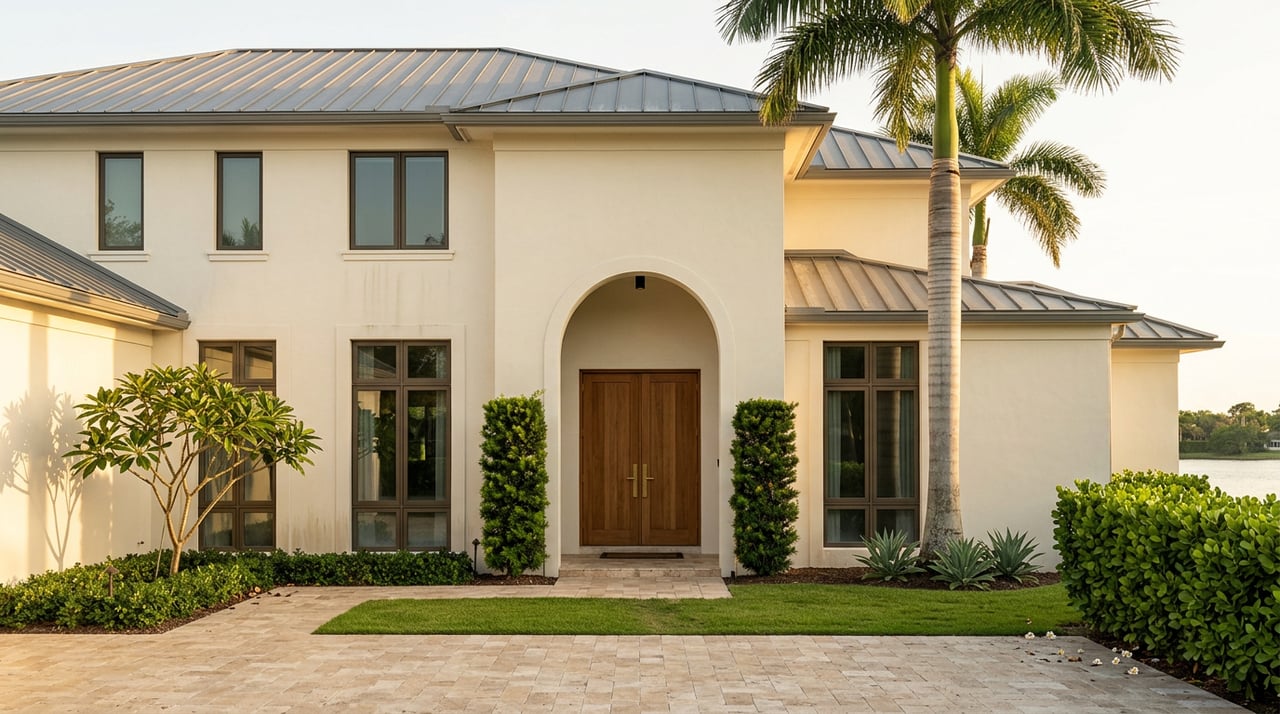
What the Aqualane Shores Real Estate Market Reveals
September 3, 2026
September 3, 2026
How can a neighborhood's median home price fall by a third in a single year while its average price doubles over the same stretch? That is not a hypothetical. It is what the numbers for Aqualane Shores showed for the three months ending June 2026: a median sale price down 33.9 percent year over year to $8.6 million, alongside an average sale price up 100 percent to $10.5 million. Same neighborhood. Same season. Two headline statistics pointing in opposite directions.
If you are comparing Naples waterfront enclaves from a spreadsheet, that kind of whiplash looks like noise you should ignore, or worse, like a red flag. It is neither. It is a very specific and very useful signal about how Aqualane Shores actually trades, and understanding it will tell you more about the neighborhood than either number alone.
Only 8 homes sold in Aqualane Shores in June 2026, down from 15 in the same month a year earlier. Across roughly 350 to 370 total single-family homesites in the neighborhood, that is not a market generating enough transactions to produce a stable median in any given month. It is a market where one closing can swing the reported number by hundreds of thousands or millions of dollars, because there simply isn't enough volume to average it out.
This is why the median and the average can tell contradictory stories without either being wrong. A median responds to whichever transaction sits in the literal middle of a very short list. An average gets pulled hard by whichever single outlier happened to close, whether that is a modest 1970s ranch on a narrow canal or a newly finished six-bedroom estate with a cut-in boat slip. When your total sample size for a month is eight, one closing at the high end can lift the average by a factor that would be statistically meaningless in a market moving a hundred homes a month, but is entirely real here.
Days on market tell a similar story from a different angle. Homes in Aqualane Shores are taking an average of 156 days to sell, down from 217 days the year before. That is not sudden acceleration in demand. It reflects which segment of inventory happened to move. A well-priced, move-in-ready new construction estate near Third Street South sells on a different timeline than a dated original that needs a buyer willing to commit to a rebuild.
The reason the aggregate numbers behave this way is that Aqualane Shores is not one market. It is two, trading side by side under a single neighborhood name.
| What's actually trading | Typical price range, mid-2026 | What it reflects |
|---|---|---|
| Original 1950s-1970s homes, unrenovated | Roughly $1.7 million to $8 million | Priced primarily for the land beneath them |
| New-construction and recently completed estates | Current listings run to nearly $20 million, with newly completed deep-water estates reported above that figure | Full rebuild cost |
| Standing lots and teardown parcels | Roughly $5.95 million to $12.4 million | Land scarcity, independent of any structure |
| The 820 Jamaica Lane assemblage | Not publicly priced | Nearly 4 acres, 858 feet of continuous frontage, the largest land offering the neighborhood has seen |
Aqualane Shores was dredged out of mangrove swamp and platted in 1949, the same year Naples incorporated as a city. Many of the original homes on those lots are still standing. Many others have already been rebuilt into six-thousand-plus-square-foot compounds by builders and architects including Toscana Homes, Stofft Cooney Architects, London Bay, and D. Garrett Construction working alongside architect Jon Kukk. When a legacy home from the first category sells in the same month as a finished estate from the second, the reported median or average doesn't describe a market trend. It describes which category happened to close.
Every one of those rebuilds resets what a finished home costs to produce, and the finished product enters the market at new-construction pricing, not at a renovated version of the old one. That's the structural reason current Aqualane Shores listings for newly completed estates run as high as nearly $20 million, with newly completed deep-water properties reported above that mark, while original homes are still transacting in the low single digit millions. It isn't two tiers of buyer taste. It's two different cost bases for the same land.
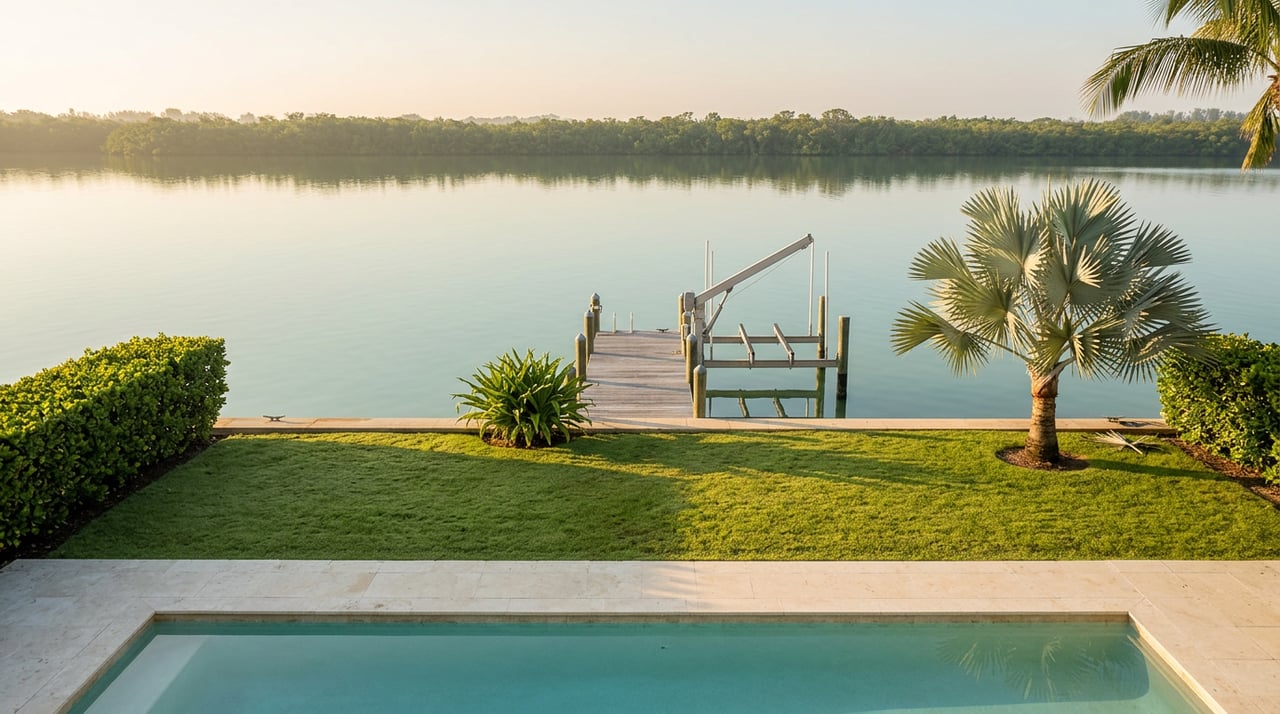
Layer scarcity on top of that. Aqualane Shores has fewer total homesites than Port Royal's roughly 500, and the supply of buildable or assemblable land inside the neighborhood is effectively fixed. Every rebuild permanently removes one more original home from the pool of what's left to convert, which is part of why a listing like the 820 Jamaica Lane assemblage, nearly 4 acres across seven contiguous lots with 858 feet of continuous water frontage and three boathouses, gets described as among the largest land offerings the neighborhood has ever presented. There is no mechanism by which Aqualane Shores gains more waterfront. There is only a mechanism by which what exists keeps getting rebuilt at a higher cost basis.
None of this means Aqualane Shores is overpriced or underpriced relative to Port Royal, Olde Naples, or Park Shore. It means the headline median is the wrong tool for that comparison. If you're evaluating Aqualane Shores against another Naples waterfront neighborhood, the number worth asking for isn't the trailing median sale price. It's price per square foot segmented by construction era, since a blended figure across 1960s originals and 2026 completions tells you almost nothing about what a specific purchase will actually cost.
The same logic applies to land. A standing lot or teardown parcel in Aqualane Shores should be evaluated on price per linear foot of water frontage and canal depth, not compared against finished-home pricing at all. Canal depths here range from 8 to 16 feet with no-bridge access to Naples Bay and the Gulf through Gordon Pass, and that variance in frontage and depth, not square footage of an existing structure, is what drives land value on streets like 4th Street South or around Aqua Cove and Ibis Cove.
For a buyer weighing Aqualane Shores against a neighborhood with a thicker, more liquid transaction history, the honest comparison isn't "which median is lower." It's "which cost basis am I actually buying into: a legacy structure priced for land value, or a rebuild priced at current code." Those are two different purchases with two different holding strategies, even when they carry the same neighborhood name on the listing sheet.
Is Aqualane Shores' price drop a sign the market is softening? Not on the evidence available. The 34 percent median decline and 100 percent average increase are for the three months ending June; the 8 sales figure is for June alone. Together, those figures point to a mix shift in what closed, not a change in underlying demand.
How many homes are actually in Aqualane Shores? Listing sources put the total between roughly 350 and 370 single-family homesites, developed almost entirely along the neighborhood's deep-water canal system with direct, no-bridge access to Naples Bay and the Gulf.
Why are new construction prices so much higher than older homes in the same neighborhood? The two types of homes have different cost bases: the finished product enters the market at new-construction pricing, not at a renovated version of the old one.
Reading a single median or average for a neighborhood this thin will mislead you more often than it informs you. Reading what's actually trading, at what construction era, on what frontage, tells you something real. If you're comparing Aqualane Shores against other Naples waterfront neighborhoods and want that comparison built on the right numbers rather than a blended headline figure, Gulf Coast Luxury Group can walk you through the current inventory segment by segment. Schedule a Private Concierge Consultation to start.
This article is general information, not legal, tax or financial advice. Consult a qualified professional about your situation.
October 22, 2026
October 15, 2026
October 8, 2026
October 1, 2026
September 24, 2026
September 17, 2026
September 10, 2026
September 3, 2026
August 27, 2026
Your journey is not just about transactions; it’s about securing your future and protecting your interests, and we’re here to make that happen. Contact us today!